
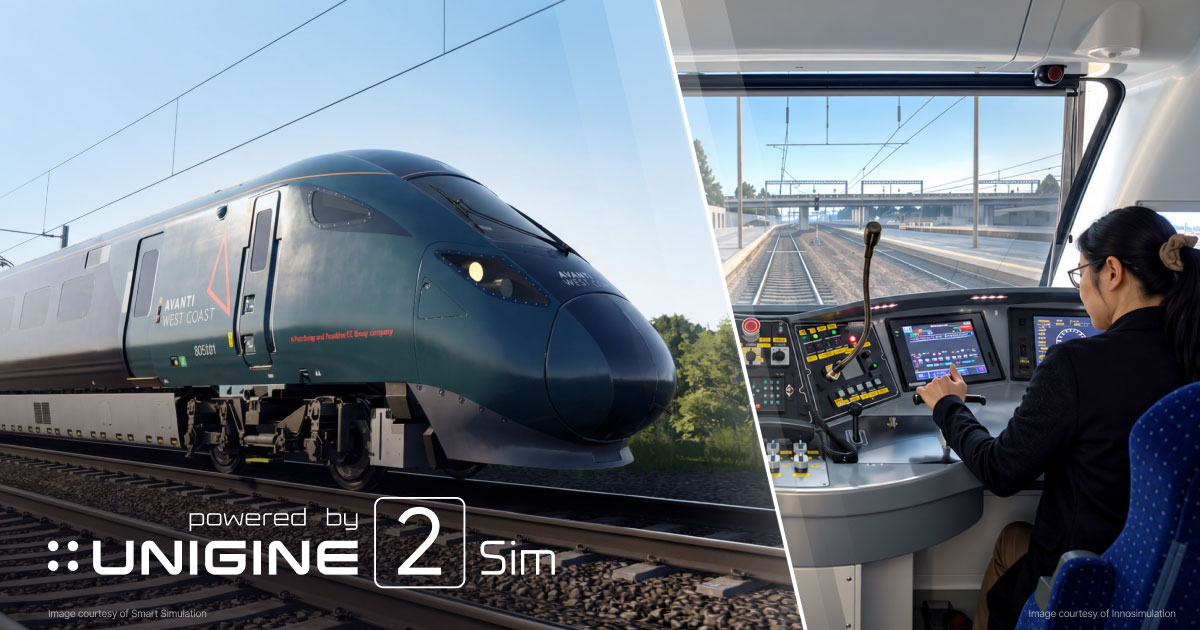
A typical railway simulation scene may be only a few hundred meters wide — but it can stretch for hundreds or even thousands of kilometers along the track.
UNIGINE 2 Sim powers many railway training systems around the world: simulators for passenger and freight train drivers, metro and tram operators, monorail systems, as well as platforms used for rolling stock maintenance and diagnostics training.
478 km.
That is the length of the longest straight railway track in the world — a section of the Trans-Australian Railway crossing the Nullarbor Plain.
Simulating infrastructure at that scale requires an engine designed for large coordinate spaces.
UNIGINE uses 64-bit world coordinates (double precision), allowing stable simulation of environments spanning thousands of kilometers. Many real-time engines — for example Unity — rely on 32-bit coordinates and require workarounds to handle worlds of that size.
But real railways are not just long tracks.
A typical railway is a complex network of routes, switches, stations, depots, and signalling systems. Training simulators therefore need tools that allow instructors to adapt the environment to a specific railway network or operational scenario.
This is where track builders and scenario editors become essential. They allow training centers to recreate real infrastructure and design custom training situations for their operators.
Another important aspect is the vertical track profile. Unlike cars, trains cannot climb steep gradients easily, so elevation changes and slope limits must be modeled accurately.
Many of these tools have been developed by our customers using extensions for the UNIGINE Editor, which provides a flexible foundation for building custom simulation workflows.
Railway simulators help operators train for situations that are difficult — or unsafe — to reproduce in real life:
- obstacles appearing on the track
- extreme weather conditions
- handling heavy freight trains
- working with signalling and dispatch systems
Another surprising fact: trains cannot stop quickly.
A passenger train traveling at ~200 km/h may require 2–3.5 km to come to a full stop, while heavy freight trains may need 1–2 km or more even at lower speeds.
The reason is simple physics: steel wheels on steel rails provide far less friction than rubber tires on asphalt.
Weather can make things even harder. Rain, snow, ice — and even fallen leaves — can dramatically reduce traction between wheels and rails.
That’s why environmental realism matters in simulators. In one of our projects we spent considerable time tuning windshield effects in the driver’s cab — water, dirt, snow, frost, and even cracks — so that operators experience conditions close to real life.
And one more engineering detail: in a long train braking does not start simultaneously in every wagon. The pneumatic braking signal travels through the train gradually, meaning the rear of the train begins braking noticeably later than the front.
These real-world constraints are exactly what make railway simulators such an interesting challenge for real-time 3D technology.